Saturday, June 11, 2022

Ethics in PR leadership - is there such a thing? Yes.

Lori Stem

loristemou@gmail.com (ls603219@ohio.edu)

I worked for a few years at a media company...a company that published trade magazines, among other things, in the horticulture and agriculture space. Long hours and hard deadlines. That was life.

I supported two publishers and three directors for five brands, worked alongside the sales staff, teamed up with the media department, and helped our journalists and events colleagues as I could. Top this off with an hour commute each way to the office and back, longer during snowstorms. Oh, did I mention it was also while being a main caregiver for my grandma with dementia and a part-time student? 

I learned plenty, and made some great friends along the way, but am happy to be in a fully remote role with no overtime! No overtime. What a difference that can make. 

Skeleton crews are exhausting

Credit: Photo by Artur Tumasian on Unsplash

Our company owner had the mindset that employees work harder the busier they are, so to say we were short-staffed was an understatement. We were like a family, a dysfunctional one at best, but tight-knit either way.

Leadership can transform a business - sometimes for the better, sometimes for the worse. Many people are leaving that company now, me being one of them recently. Many employees spent their whole 30-plus year careers there. But it's changed. This BBC article talks about some social aspects of high turnover.

Burnout did NOT affect high ethical standards in this case (miraculously)

We worked our butts off to meet hard deadlines for lower than industry standard pay. Top leadership, including the owner (mostly the owner), sent out confusing and controlling communications, complete with plenty of mind games. But our journalists and sales staff practiced their art with the utmost ethical standards and sound judgment. Not all companies are this lucky.

We were proud of our standards and were considered industry front runners for decades in the hort and ag space. Unfortunately, one can only deal with such high stress for so long before realizing it's just not healthy or sustainable.

Work environments are key, and so are the leaders

I was the middleman between PR professionals and our journalists as well. I filtered through email after email, learning which ones to forward to our journalists. I never wondered what the PR firm's work environments were like since mine felt all-consuming.

So what makes a solid work culture? What expectations are in the PR world of their leadership? What even makes a successful leader?

There are some things that come to mind:

  • One that promotes ethical standards.
  • One that practices what they preach.
  • One that creates and maintains a culture of professionalism built on trust.
  • One that does not cut corners and leads with a vision.
  • One that includes diversity in employees and ideas.
  • One that fosters honesty and transparency, and leads with integrity and empathy.
  • One that includes company standards and policies front and center, in the office, and to the public.
  • One that actively listens and welcomes positive change.
  • One that does not lead with fear, but with service. 
Interested in learning more?

Credit: Freepik.com

Here is a study on the topic of leadership skills in the PR industry. Meng and Heymen lead the Conclusions and Implications section of their research with, "this study was motivated by a desire to understand how leadership has been defined in the field of public relations and the key dimensions an effective public relations leader should possess." It's worth a read when the time allows.

If you learn better by watching or listening, take a quick five minutes to enjoy this video...

Credit: YouTube

Thanks for reading! What are some leadership failures and successes you've encountered?


There are lies, dammed lies, and astroturfing.

Astro world? Astro what??


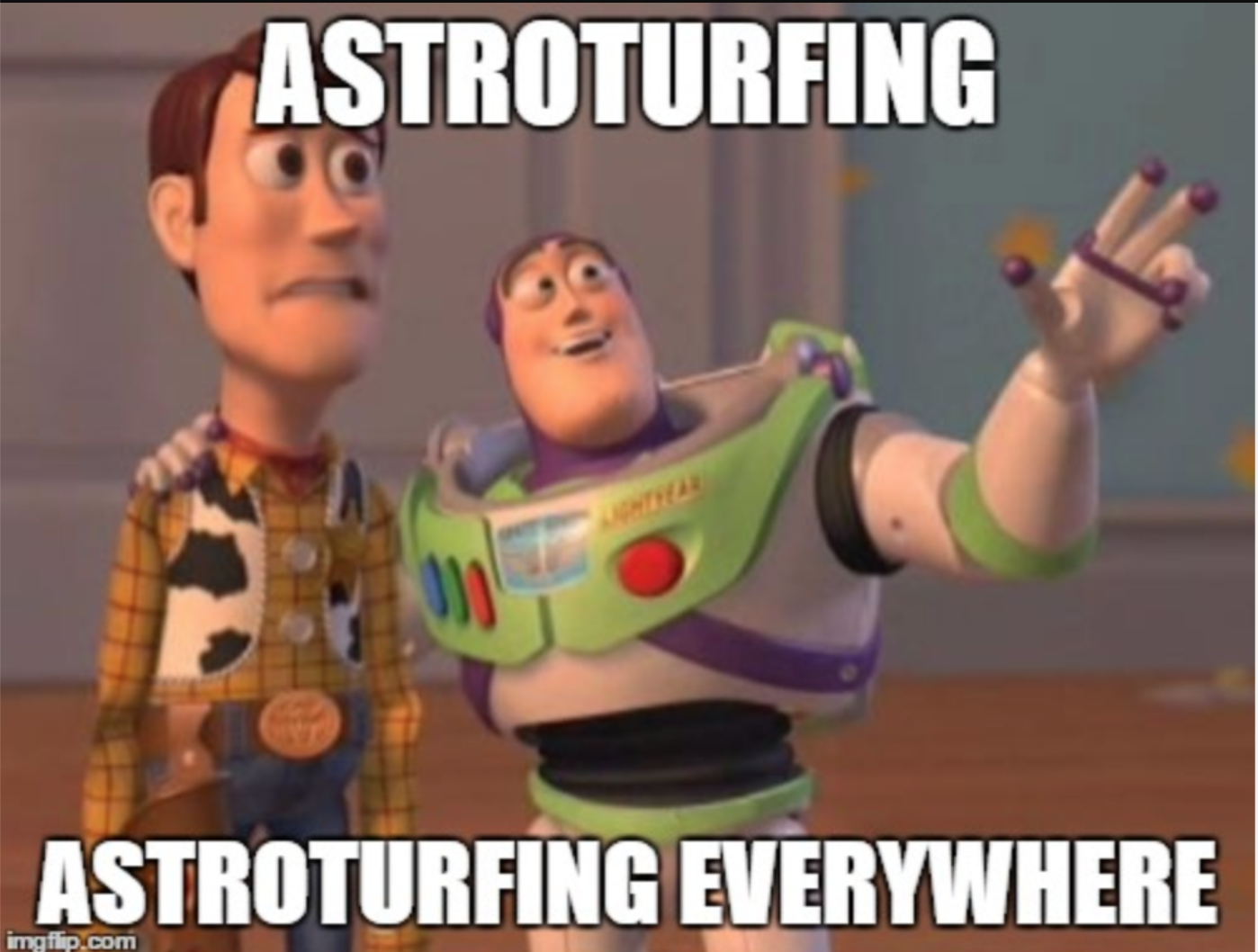
No, not astroworld, that was a disastrous concert earlier this year. We are talking about Astroturfing. With the whizz of all the craziness on the internet, you are probably thinking...when will it ever stop? Firstly, we can understand astroturfing as the practice of masking the sponsors of a message. For example, political, advertising, and PR, to make it appear as if this message is coming from a grassroots organization. In the end, this can alter public perception because it makes people second guess their own thoughts or opinions because another viewpoint is so widely supported...or is it? This support is artificial, just like artificial grass, called turf, hence the term "astroturfing". It's hard enough to keep up with the news today anyway, and breaking down what is real from what is false anyway...now this?


https://imgflip.com/i/1b097s
                                                        imigflig: clip astroturfing 


Clickbait or nah?

Now, it is no secret that as human beings we have a curious nature and we are going to give a click to whatever catches our eye. This might be a new set of golf clubs on a sporting website, or a new fancy mop bucket...the possibilities are endless.  When it comes to news, there is no difference,  people just click on the news that has a catchy headline, and most people don't spend much time investigating the sources they obtain their news. This is why astroturfing can become so problematic because many people who fall victim to astroturfing seldomly realize there has been any foul play. 


Now there's...bots?!

We've all heard of "bots" on different websites, but what is the impact they have? Companies that partake in astroturfing also use bots to show they've got support for their movement in "numbers" of online personas. Firstly, these might seem harmless because we don't often think about them, but they are not harmless. I can think of one way a bot has personally affected YOUR choices...you might be thinking, no way! Well, have you ever purchased an item on amazon based on the reviews you've read? It was estimated in 2022 that 61% of Amazon reviews on electronics alone are fake reviews written by bots. False bot-generated reviews have directly impacted your decision to buy something---that is insane! 

Think about more devious ways bots can be used- think of a moral objection you've got to something. Then you see on Twitter, or Facebook that there's overwhelming support for this specific issue, and it makes you feel like an outlier for not going with the crowd.  This can sway the opinion of people, very easily, because there is a lot of research behind the strength of mob mentality


Legality...question mark...

Unfortunately, like most things on the internet that seem absolutely scandalous...there is a lack of regulation for them. Astroturfing, while morally wrong on many fronts, is just another form of campaigning ploy that has been pulling the wool over Americans' eyes. This is just a bit scarier because it's not just a shampoo brand promising you to have no frizz, and a million people aka "bots" confirming the claim that you will have the sleekest hair you've ever seen. There are politics involved, which sway people, and leads to legislation that impacts the lives of people on a much larger scale than if everyone was suffering from frizz. Like most things in this world, there are dollars to be made, and corporations arent going to stop--even if what they are doing really sucks. We can only push back against these types of deceptive tactics and cross our fingers that legislation would be passed to prohibit Astroturfing. The problem is...the same people we want to pass laws against Astroturfing are also the ones greatly enjoying the benefits of it!


The Deceptive Practice of Astroturfing

 Elly Merrit

em489621@ohio.edu


    The invention of the Internet has been a wonderful gift for mankind. As with any good inventions there are also those waiting to profit from the new experience. The Internet "is also bonanza for corporate lobbyists viral markets, government spin doctors, who can operate without regulation, accountability or fear of detection".  Everyday these operations grow more sophisticated, effective, and dangerous. Astroturfing is the deliberate attempt to manipulate public opinion through deceptive practices. 


    The ability to create false identities and maintain anonymity has provide companies with an avenue to run Astroturf operations. Astroturfing benefits creators. They establish web campaigns that present the idea that large numbers of people are revolting or opposing a particular event or policy. Let's look at a few examples of how Astroturfing may appear. The logo for the National Wetland Coalition suggests an environmental friendly organization however, the NWC is a front group that opposes federal policies that regulate the development of United States wet lands. This so called coalition receives it's funding from oil companies and real-estate developers.  

NWC


        The Center For Food Integrity is a industry funded organization aiming to promote consumers trust for processed foods, food additives and antibiotics in meat. The direct opposite of what would be expected from a organization on food integrity. It is not always easy to see what a companies motive really is. The American Council on Science and Health receives funding from chemical companies, e cigarette manufacturers and fracking corporations. This group is a pure straight up opposition to science and health. On their website they provide a wide range of articles that may remind a person of the headlines on the "National Enquirer." The titles include "Pesticides Negate Benefits of Fruits and Vegetables Consumption? No" also "Is the EPA Really Following the Science on Form aldehyde? and last " Oreology: A Study of Oreo's Stuffing." If a person decides to read one of these articles, they learn nothing. 


        Astroturfing is not limited to the website, they often obtain questionable experts to testify to their cause. Also organizations may hire fake protesters or advocate to create the illusion of support. Fake websites, fake advocate, fake experts, fake protesters can affect real world change and do real damage. Astroturfing is dangerous and can cause people to be mislead with false information. 

Friday, June 10, 2022

Don't be fooled...it's astroturfing

The whole idea of astroturfing is very interesting. This reminds me of Twitter bots. Fake accounts seem to have taken over social media and that's the first thing that comes to mind when I hear about astroturfing. The fact that any system can be created to be so sophisticated that fake campaigns can be started actually get real people to follow without blinking an eye is amazing. 

It's also scary to know that it's that easy to start so many fake online accounts that are smart enough to convince people that whatever propaganda they're  spreading is the gospel. This is why we need to research and pay attention to what we consume via the internet. With so many fake social media accounts and websites popping up we've entered a dangerous time. 

With astroturfing companies can pump their agenda through online messages using multiple fake accounts disguised as real people and create a following of thousands or more within hours potentially. With the right message attached to an agenda that a certain section of people care about this phenomena has the potential to cause major harm.  


                                               Source: Last Week Tonight w/ John Oliver (HBO)

This can be one of the easiest ways to spread misinformation among the masses especially if it involves a controversial topic. The matter of Roe v Wade and abortion has been in the news again recently with some states attempting to outlaw abortion. This type of polarizing topic is prime real estate for those against abortion to rile up those wanting to do away with legalized abortion. 

Since the internet isn't really regulated it makes one wonder what can be done. Like with anything, the criminals or bad people are always a step ahead. But is the breaking the law? Sure, if this astroturfing leads followers to commit unlawful acts based on following or supporting agendas pushed by companies using fake accounts then maybe that's a conversation to be had. But as with most cases that bridge won't be crossed until we get to it. 

For now it's up to real people to be more attentive and pay attention to whom they choose to engage with and follow online. At this point I'm everyone that has an online profile of some sort has interacted with one or many of these fake accounts for one reason or another. We must be careful to not get too wrapped up in any movement that we follow blindly without first asking questions and assuring ourselves that we're on the right side of the argument.

Fifty Shades of Green

Gina Thurston

gt213919@ohio.edu


Astroturfing, say again?

We all know astroturf is fake green grass, usually used for sports fields or in areas where grass doesn't grow or stay green naturally. It's the appearance of real grass. Understand? Okay, good. 

With that in mind, let's take the term grassroots, which is a movement from the ground up, meaning it starts with concerned citizens...or just citizens, us ground-level folks. When I was younger, I was a fan of a very talented local band. We hung posters and spread the word of this band from Vancouver, BC to LA, eventually they were signed and became somewhat famous in the early oughts. I was part of a grassroots fan club.  

So- the term Astroturfing means a FAKE grassroots movement. Now, that doesn't sound like any fun at all. Who would create such a group, and why?

The Who is INDUSTRY. Industries that are doing things or producing things that are harmful to people and the planet. Industries that don't want to lose profits or change the way they operate, are usually behind astroturfing. 

(A list of companies known for their astroturfing deceptions can be found here, it's not surprising...)

The Why is to create doubt, like in science, where there are never absolutes. Or to create the impression of being a spontaneous grassroots behavior and to disguise the agenda as an independent public reaction to some political, product, service or event. 

There are many ways a company can use astroturfing to deceive or mislead the public by pretending to be a concerned member of said public. 

  • Fake positive reviews on that company's products
  • Fake negative reviews on competitor's products
  • Creating fake personas aka "sockpuppets" on social media and popular message board sites which spread similar posts to create the illusion of a populist idea. 
  • Pay-for-play deals with influencers and bloggers to promote your product in exchange for gifts.
  • Paying people to show up at rallies and protests


    We can't talk about Astroturfing without talking about its dirty first cousin, the Front Group:

    Something that industry lobbyists tend to do is hide who they are when they are trying to manufacture doubt about science or a particular cause. 

    A good example of a front group that acted like they represented concerned citizens, but they actually represented corporate interests was the Global Climate Coalition. This organization looks like a group collaborating between scientists and concerned citizens. So when they argue that climate change doesn't exist/we can't do anything about it/science is too uncertain...it seems to represent a legitimate group's concerns. 

    However, if you look closely at who is funding the Global Climate Coalition, there is not a single concerned citizen in the mix. It's all the energy industry giants who want to appear like they are neutral and objective, but they are just pushing their agenda in an extremely deceptive way.

    Another example: Pretend McDonald's came out with a mass media marketing ad that stated the Big Mac was nutritious and good for us. Most of us would be skeptical because we know fast food is probably the least nutritious food of all, plus McD's has a huge incentive to lie about something like this. So, McDonald's, being this billion-dollar company, knows better than to even bother. 

    Now pretend there was an organization called "American Health Coalition" staffed with 300 "expert nutritionists" that came out with the statement that Big Macs are nutritious. That changes everything, doesn't it? Well, the coalition is owned by McDonalds and all the other fast-food franchise billionaires, and they pay the experts $$$ to make these false statements. 

    "Uproot" the fake grassroots....

    With doubt being the product, people need to learn how to identify phony grassroots organizations and their campaigns. Websites such as SourceWatch and DeSmoggBlog thoroughly research groups involved in these campaigns and do their best to inform the public when the industry is trying to dupe us into thinking their harmful tactics are in our best interest. 


    Ethical Standards of Public Relations

     Holly Friedel 

    hf004717@ohio.edu

    Ethical Values 

    A lot of my blog posts have surrounded the importance of honesty and transparency in the journalism world. As I investigate and learn more about public relations, I have discovered the importance of a similar moral compass in the industry. I will admit, originally I thought it was a field where you represent and say what a company wants you to release to the public for their own benefit, and where you, as their representative, obtain a greater profit because of it. As I have matured, I have found how important it is to be an honest public relations company, and not only please your client, but follow the responsibility of sharing truth and accuracy to the public, essentially following an ethics code.

                                                                        Getty Images


    Top to Bottom, not Bottom to Top

    Large corporations are no stranger to disobeying and plain right ignoring ethical standards; and as we have seen in many cases, specifically looking at the Murdoch scandal, we see the people at the top blaming their employers for ethical concerns questioned and judged by the public. But, it is ultimately the role of the boss to be aware of activity by employers, particularly if illegal activity is being conducted within companies. So, as we see in the Murdoch case, the public did not show aggression towards employers, but the man in charge of it all, showing society blames the top, not the bottom. In many cases, employers break rules due to pressure from owners, CEO's, managers, etc. Pushing deadlines, sales, and personal agendas can create an environment where employers feel they have no option to but to break the rules, and those rule breaks can take down an entire empire. 

    The Solution

    Their are many things large and small corporations/companies can do to create an ethical policy and business overall. I find it would be very beneficial for large companies to engage in a focus on ethical standards, because even today we see the biggest company in the world, Amazon, face backlash on certain ways the company is run and treatment of employers. Advice for the companies would be: 

    —Provide examples of ethical disasters and as a corporation discuss the issues of it while also discussing what should have been done.

    — Bring in outsiders. Someone with no connection or bias to a company can review the morals and ethical standards of a company and potentially point out something that went unnoticed from employees within. 

    —Create a plan of how you want to see change within the company, and provide open forums where employers can comment on the issues they see or are first hand dealing with. 


    Journalism in the Music Industry: Standards of Practice

    hf346318@ohio.edu

    Hunter Folks


    Ethical Conflicts

    Conflicts of interest are incredibly difficult to navigate in the journalism industry. In traditional journalism, organizations and individuals have well defined codes of ethics to look towards for guidance in potentially compromising situations. While these codes of ethics do not have a standard across the industry, they do provide a reference with which journalists can guide themselves.


    However, things get murkier once you enter the realm of music journalism. For journalists themselves, even more so. The community is small, and simply representing a large media company will not get you in the door like it will in other parts of the media industry. Instead, building and maintaining relationships with key individuals with inside access to musicians is considered standard. This behavior is at the root of music journalism, and where the ethical dilemma begins.


    Some of the most famous ethical dillemas within this industry are pay to play or “payola” schemes. Most recently, Sony BMG Music Entertainment was involved in a scandal where they were caught paying employees of radio stations to give more airtime to their featured artists. This is the oldest and arguably the most easily identified type of ethical conflict within the industry. 


    Breaking Tradition

    In traditional journalism, giving or receiving any gifts in exchange for information or the potential for information is considered unethical. In music, extravagant dinners and lavish album release parties are standard. Oftentimes to interact with individuals in the industry requires accepting some sort of gift to even get in the room. Additionally, the industry has a long memory and strict control over who can access information. This means that a harsh negative review or op-ed can result in being blackballed nearly industry-wide. Unlike other types of news that often has multiple avenues for information gathering, being blackballed in music journalism would mean a complete lack of access to any information in a timely manner.

    Image
    Image: Source


    There is also the dilemma of paying for access to address. Industry events do not follow a standard system, although they tend towards specific event types. Oftentimes the most pressing new information is found at up and comers album release parties, or clubs. These are not always free events. If you are not a large and favorable news outlet, you likely will not always get in for free. That is if you can get in at all.


    They Know What They're Doing

    The music industry very purposefully sets up journalists to get caught in a web of ethical issues. When your job is to report on industry happenings, oftentimes you can be put into a position where you are forced to make choices that do not have a completely ethical answer in the frame of traditional journalism. A poor review of a label’s artist could result in having to pay to access information-rich events in the future. In that situation, curtailing your review or paying for access are both traditionally unethical, but you still must make the choice.


    Fortunately, I believe the solution is simple and already commonplace even if it is not acknowledged. The idea of ethics is based around our cultural standards, norms, and values. In music, the behaviors mentioned previously are standard. I believe it is a journalists duty to navigate in the most ethical way possible, however, exceptions to traditional rules can be made if the industry demands it. For example, in the video game industry it is standard for reviewers to be provided copies of the game for free, and ahead of release. While this is a “gift”, it is so normalized that reviewers consider it an expectation rather than a “gift”. If party invitations and paying for event access is considered standard in music journalism, then it is the journalist’s responsibility to judge every dilemma and decide if it goes above the standard.