Tuesday, November 30, 2021

Click at Your Own Risk: How The Web Watches Us Back

 Emily Baron

eb113717@ohio.edu
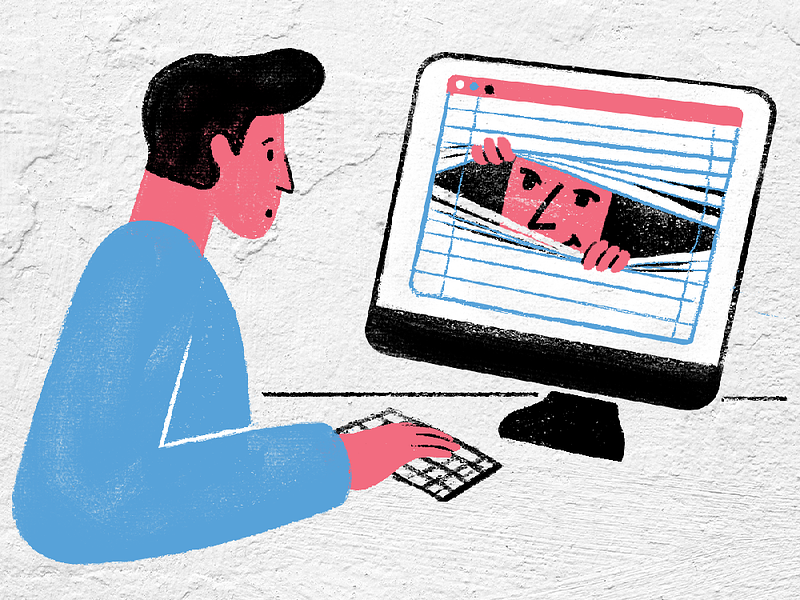
Full illustration credits to Alyona Brailovska

    Welcome to the digital age; An age in which technology is integral to day-to-day life and can be found on our desks, in our homes, in our hands, and even
flying in our skies. As a journalist, it is easy to notice the massive influence technology has on the way we receive and process information. What once was a job that required ink, paper and a writer is now a job that is dominated by the internet’s influence, with less and less printed media hitting the shelves and switching to online than ever before. 

People today are constantly surrounded with technology and observing its content, like when we scroll through social media or when we indulge in scouring online articles and blog posts, but what if the observed content is observing us right back? Journalist Rami Somaiya for the Columbia Journalism Review points out how intricate the algorithm for the company Google is, "...with analytical tools to look for attention spikes on a variety of topics,” in order to strategically place personalized content to the top of readers’ screens. “Success means that more people click. It is, roughly, the business model of pornography,” Somaiya asserts.

Amassing clicks from internet-users is the ultimate goal for content creators. Google is not the only online platform with clickbait specifically tailored to analyze and individually manipulate the delivery of information to its users; Facebook is full of it too. Online content creators Goldman and Wade openly admit that in making Facebook posts, their goal is not to share accurate information, but to intentionally cram as much attention-grabbing vocabulary and imagery as possible in a headline to garner more clicks, or, more cash. They pay great attention to the statistics of each article, without taking their eyes off of the number of views or hits. Journalistic integrity and honesty is not on their radar as increasing profit is.

With people like Goldman and Wade rapidly spreading misinformation on Facebook, baseless media content or "fake news" is clouding timelines like never before alongside a plethora of other stories purposefully positioned to manipulate the viewer. As active members of digesting digital information, it is imperative for readers to consider what headlines are meant for disseminating knowledge and what headlines are deliberately sensationalized to trick and deceive. Clicks are currency: spend them wisely.

Monday, November 29, 2021

How Technology has changed Journalism: Make up Blog

 Ella Umbarger

eu594318@ohio.edu


    Currently I am taking coms 3200: Communication and New Technology. Through the semester I have learned a lot about how technology has affected communication. Through social media many things have changed in communication and journalism. There are new ethical conflicts that have now risen. 

    
    Clickbait has taken over online reporting. Using clickbait techniques can greatly mislead an audience. Clickbait goes against the SPJ code of ethics. “ Never deliberately distort facts or context, including visual information. Clearly label illustrations and re-enactments.” Using a dramatized title like they do in clickbait articles deliberately distorts the facts and their context.


     Many people compare clickbait to online yellow journalism. Yellow journalism started in the late 19th-century and journalists used sensationalized or biased stories in their reporting instead of the impartial truth. Some characteristics of yellow journalism can still be seen in clickbait journalism today. 


                                                                    Source: Oliver Munday    

    From the article,  it seems that Goldman and Wade only care about the number of clicks they get and the money they make, not actual reporting. Although money is a huge motivation for anything, I think if that is your only motivation for reporting it may lead to some unethical journalism. They use tactics such as exaggeration, stoking fear, inflaming racial and gender tensions, and using conspiracy theories to capture their audience. 


    Sharing “news articles” via social media can lead to a lot of misinformation or “fake news”. Ravi Somaiya said , “Facebook is a toxic town square. Social media is Christmas for fraudsters.” and “The best way of sifting the information we find online is, simply, to report before we publish, as we would offline.”  


    Following the ethical codes biased on traditional print media can still be applicable but there are ethical codes specifically for online journalism. The center for journalism ethics has provided a guide for digital media ethics.  It goes over some difficult questions in the age of digital media journalism. They cover anonymity, speed, rumor and corrections, Impartiality, conflicts of interest, and partisan journalism,  entrepreneurial not-for-profit journalism, reporters using social media, citizen journalists and using citizen content, and ethics of images. 


    I believe that educating yourself about these ethical dilemmas and looking at professional codes can help alleviate some of the issues of online journalism. Also as an audience not clicking on stories that have obviously sensationalized headlines can help not give this unethical journalism the attention it seeks. The less clicks the articles get could help steering it in the right direction. 


Friday, November 19, 2021

Addressing Hate Crimes in the Media

Claire Schiopota

cs123719@ohio.edu

In the age of Black Lives Matter and white supremacy, current news outlets have had to take a special look into how they cover hate crimes. Finding a balance between reporting on these issues without giving controversy a platform to thrive on comes with experience over time. Today, many reporters struggle with this concept. 

According to the Bureau of Justice Statistics, more than half of hate crime victims don't file reports to the police (What We Discovered During a Year of Documenting Hate — ProPublica). Last year almost 90% of local law enforcement agencies reported having zero hate crimes in their communities. Ultimately, this all shows that hate crimes already lack accurate coverage. The media must pay extra attention to the actions they take with this in mind.

While there are many things in journalism that must be closely payed attention to, there must be a special emphasis on journalism rules when reporting on hate crimes. 

The language must be extremely precise as to not sway the audience to one side or another. The Poynter (How journalists should handle racist words, images and violence in Charlottesville – Poynter) said, "Be wary of subjective adjectives and unclear labels, like far-right or alt-right. Instead, describe what protestors were doing, what they were saying and what they were demanding. Be precise. It is not enough to simply call the marchers White nationalists." Journalists have often found themselves caught up in corrections for incorrectly naming or grouping individuals.

Every photo and video used in association with the story also must be given for context for use. The Poynter said, "It may be tempting to omit from coverage instances of violence committed by counter-protesters because their side is standing against racism, but video shows violence from both camps. It's not always clear who is on what side. Use captions and narration to make it clear." Both sides of the story needs to be told and accurately represented. Just like journalists need to watch the words they use, they also need to watch the images and videos they show. It carries just as much weight, if not more. 

When we report on hate crime, we always run the chance of giving a platform for white supremacy and other controversial perspectives. There always may people who had never heard of these issues until we report on them, but if we inform our audiences accurately and effectively, we did the best we can to avoid this problem.

As a student journalist, I haven't had many opportunities to cover hate crimes, but it's important for me to inform myself now before I have to do so in my future, as I'm sure I will have to. 


Thursday, November 18, 2021

Delano Massey talks to student journalists about what he does as the producer for CNN's Race and Equality Team

Erin Ashley

ea350918@ohio.edu

Delano Massey, an award-winning journalist, started out as a police reporter in St. Louis, Missouri, which is an incredibly impoverished city with lots of crime. He stated that it was difficult to get information as a police reporter but that he learned a lot.

On November 8, Massey, who was selected to be the producer for CNN's Race and Equality Team, gave a virtual speech to student journalists about what he does as a member of his team. Massey clarified that this team hasn't always been around, and it only arose in the year 2020.

CNN President Jeff Zucker stated that the creation of this team was to break news and cover stores surrounding race and systemic racism, which is something that has plagued the media since the heightened media presence of the Black Lives Matter movement in the year 2020. Because of the protests that broke out in 2020, Zucker believes that Americans now recognize how many facets of life are plagued by systemic racism.

Massey clarified that "this stuff is cyclical", meaning that there are patterns in the stories that his team covers.  Zucker believes that the patterns of racism have been shown in more indirect ways, such as lack of representation in leadership roles and inequality in business, politics, and even the media.

Graphic courtesy of Pew Research Center

With Donald Trump being president during the Black Lives Matter movement protests, Black Americans expressed discontent with how Trump relayed his response to the protests that resulted from the death of George Floyd. However, on the other hand, Black Americans felt that news organizations that covered the protests that resulted from the death of George Floyd did a much better job than Trump.

Massey discussed how one of the first major things that his team covered was the case involving Breonna Taylor, a Black woman whose house was broken into by police which resulted in her death. He expressed that as the producer of this team Race and Equality Team, his job was to tell his peers that this story needs more attention.

Another case that Massey demonstrated interest in covering more was the case involving Ahmaud Arbery, a Black man who was unarmed and killed while going for a jog. He said that we, as journalists, need to reflect on these incredibly pivotal cases and push for more attention on them.

The creation of this team was to provide these intense cases and stories a platform and a voice. Massey stated that he and his team are simply a "vessel", allowing other people's stories to come through them.

Massey announced that his team has met resistance in the past for the stories that they cover. However, he emphasized that they must work through it in order to fulfill the promises that the team dedicated themselves to.

During the Question and Answer portion of the presentation, a student came forward and asked how white people can help tell these stories and bring justice where it needs serving. Massey asserted that white people can simply be allies, be advocates, and amplify Black voices.


The Great Divide: Right vs. Left in the Media

 Bennett Snyder

bs381219@ohio.edu


It's very clear to most that almost all major media sources nowadays lean one way politically. You've got your CNNs, and you've got your FOX news' with loads of other sources between. For someone just cracking into the depth of news sources when the election was taking place, the realization of this divide was clear as day. 

Growing up in a house where my Mom is a Democrat and my Dad was a Republican didn't make life fun come election years. When I was younger they kept it less obvious, but last year they made it clear they disagreed on a lot of topics. This comparison I believe rings true to a lot of news sources. As we are further away from election dates, say a president is in year 1 of his first term, news sources may make it less obvious which side they lean towards to try and attract all audiences. As the years go on, and that president is nearing the end of his or her term, we start to see news sources pick up the intensity and truly show their political side. 

In some cases, the person in office is so polarizing, it does not matter how far along they are in their term, they most certainly will always be the center of attention. One side will view them as royalty, one side will view them as a coward. Donald Trump was that guy. 


Image: Financial Times 

Tyler Fisher wrote a great article showing how Trump was covered by both sides of the media pertaining to the same events. After violence erupted in Charlottesville, here were a few headlines from the right: "Donald Trump Blasts Reporters at Trump Tower for One-Sided Charlottesville Reporting" and "Trump decries 'alt-left' in Charlottesville: 'Do they have any semblance of guilt?'". Now, let's look at headlines from the right: "Trump Gives White Supremacists an Unequivocal Boost" and "Trump: 'Both sides' to blame for Charlottesville". Two headlines from each side could not be more different due to the way the media is politicized.  

Covering hate is a tricky topic, nobody really likes to hate, the defeats the purpose! Hate is bad, something we should avoid at all costs in journalism. According to Rachel Glickhouse , we saw a rise in hate crimes and bias incidents as we neared closer to the 2020 election. There is no doubt in my mind we still see that connection as we continue to cover COVID-19 in the media. What I've learned is no matter what agenda your publisher has, you need to be careful your words don't spark the public to be enraged. Most times, the best way to do this, report the facts. 

Hate Needs to be Correctly Addressed in the Media

 Payton Szymczak 

ps692718@ohio.edu

notyap5968@gmail.com


White supremacy in America is not covered the way it should be to its full intensity. In the newsroom, word choice needs to be addressed when it comes to terror in America. Challenges are approached when it comes to journalists choosing the right words, and images featured in their work. 

Words and images used by journalists should be accurate. They have the responsibility to be showing truth to the public. In the article on Poynter, How journalists should handle racist words, images and violence in Charlottesville, the author states, "Bring context to the video and still photos you select. Your first duty is to explain what happened. Choose images that accurately reflect the events as they unfolded." The captions, narration, language, and word choice used should accurately display the images chosen, and the event behind the image. The article also explains how journalists should not assume that the audience reading the story already know and understand the content the journalist is displaying.  

Certain topics should be more common and intensified in the newsroom. For example, an article, White-supremacy threat demands its own beat reporters, on Columbia Journalism Review. discusses the issues regarding how the media covers white supremacy, and refers to the violent events in Charlottesville. The author states, "If more newsrooms covered white supremacy with the intensity it deserves, fewer white people might have been surprised by the events in Charlottesville...The media is preoccupied with race only when turmoil arises, such as in Ferguson and Baltimore, he argues, but over time race gets pushed down a newsroom's list of priorities." 

Making the white supremacy issue a priority in the newsroom can be an improvement. For example, the article, White-supremacy threat demands its own beat reporters, states, "By making the white supremacy beat a priority, newsrooms will cultivate reporters who grow in expertise, can avoid using PR-inspired descriptions such as "alt-right", and produces stories less superficial than some of the white nationalist coverage we've seen since the election." 

Hate needs to be correctly displayed to the public in the media. In the article, What We Discovered During a Year of Documenting Hate, on ProPublica, the author discusses how hate crimes are poorly tracked in America. The media is in need of doing a better job accurately providing information about the hate occurring in America, so that people better understand the truth behind violent events. 


Wednesday, November 17, 2021

Minimizing Harm in Photojournalism

Grace Morris

Gm245917@ohio.edu

Source: Photo Industry News, Resources, and Opinion 


 In today’s world, the saying “a picture is worth a thousand words” is more relevant than ever within the field of journalism. For journalists, the use of photos and video has revolutionized the way a story is told and conveyed to the public. However, this usage has also brought about many ethical conflicts and dilemmas concerning the subjects and the audience.  If the use of photos and videos is done poorly, this can affect the public’s view and trust of journalists.


One ethical dilemma that can arise with the use of photos and videos is the issue of the subject’s privacy. In recent years, the number of protests has increased substantially and has once again become a vital part of American activism. During these protests, journalists and photojournalists take photos and videos to document these historic events. However, many protesters have spoken up about the dangers of having their photos being taken and published during a protest.


According to an article published by the Center for Media Engagement, it states that in states like Florida, an individual attending a protest can be fired from their job or even charged with a crime. Many have called photojournalists to consider blurring out the faces of protesters to maintain their privacy and safety. However, many journalists believe that showing faces is critical for these types of stories. Journalists have also stated that blurring out the faces of protestors would impose on the ethical codes of photojournalism.


The National Press Photographers Association’s website lists 10 ethical codes and guidelines that photojournalists should always follow when producing and publishing work. The fourth ethical code that is provided states that photojournalists should treat and give all subjects respect, dignity, consideration, and compassion. In addition, the sixth ethical code that is provided states that the editing of photos and videos should maintain the integrity of the original medium’s content and context. Also, the medium's content should not be manipulated or altered in any way that can mislead the public or misrepresent the subjects. 


With these ethical codes in mind, how photojournalists decide to pursue these conflicts will inevitably affect how stories are written and pursued in reporting. This is a difficult avenue that many journalists face today. In my opinion, I believe that the faces of the subjects during these events should be shown to ensure that accuracy, transparency, and honesty are being upheld. It’s up to journalists to ensure that the images they provide are honest and accurate but most importantly, minimize harm to all parties involved.