Thursday, November 19, 2020

Hate Speech in the Era of Social Media

Emily Walsh 

ew845717@ohio.edu


As social media is now ingrained in our societies' social norms and daily routines, we can see that over-exposure to information and media has caused desensitization in many forms. How does this desensitization pose a threat to our culture? 

With the BLM movement being amplified this past summer, it has been brought to my attention the importance of being thoughtful and intentional when using social media. Many videos of black people experiencing police brutality surfaced the internet and would casually appear on your feed with little to no warning. This  brings up the concern that the video content is not educational, but rather is traumatizing viewers and normalizing racist imagery and violence. 

Another case were we see desensitization is sexual content in advertising and on social media. As many of us have heard in marketing or advertising classes, the phrase "sex sells" is commonly used. With younger and younger kids are using social media, it is important that exposure to sexual content does not impact youth in negative ways such as reinforcing stereotypes or setting unhealthy standards. 

Also, scrolling through online platforms like Twitter or Instagram looks a lot different today versus when I first got them about 10 years ago. Just as relationships look different when you are first dating your significant versus when you are 10 years married to them, as people have grown more comfortable with the use of social media, their manners and filters have become less apparent. 

A big issue that comes with that lack of manners and use of a filter is the normalization and blurred lines of hate speech. We often see strong language and opinions online, but when does something change from being the exercise of free speech to hate speech? With the current president's Twitter account being banned at times for the material he is putting out onto the platform, it is clear that this is no little problem. 

Many companies are making an effort to stop hate speech on their online platforms. According to an article by AP News, Reddit has even banned an online forum that supported Donald Trump because is repeatedly encouraged violence and broke Reddit's rules.

Allison Langley wrote on this topic that the normalization of hate speech online is harmful in that it prevents people who are fighting for freedom, tolerance and nondiscrimination from speaking up. I agree and in that sense believe that hate speech hurts free speech. 


Picture source: https://www.forbes.com/sites/kalevleetaru/2018/11/23/if-social-media-algorithms-control-our-lives-why-cant-they-eliminate-hate-speech/?sh=5b0277486c01

It is great that many companies are doing their part in discouraging and banning hate speech, but honestly it is sad that as a country, we just simply don't treat and speak to others with respect. As a culture we could do better to to be respectful to others and when we do disagree, to do so respectfully. We as journalists can help change this culture by normalizing productive communication skills such as asking questions, listening, and Tweeting responsibly. 

Hate Speech In a Modern World of Journalism

Mary Jane Sanese 

ms943920@ohio.edu


The journalism and media world is constantly changing in this modern age, especially with social media. As more people are able to write their own blogs, create their own websites, and share their opinions and world views on their social media pages, it means there is more content and news out than ever before. Before the internet, the news was produced by a smaller group of journalists, those who wrote for the newspaper, radio stations, magazines, or television news programs. But now, anyone can be a self proclaimed journalist.

As journalists, we abide by a code of ethics at every step of the news making process, from gathering the news, to writing our stories, and to distributing it. Average Joe sitting behind his computer posting on his Facebook is most likely not doing the same thing. People have a knack for saying a lot of things online that might not come out of their mouths in public, and we attribute that to being able to hide behind a a computer screen, which gives the person a sense of inflated confidence. The Ethical Journalism Network does a tremendous job in breaking down the issues that come with the increased user generated posts we are seeing on sites such as Twitter or Facebook. 

It can be argued that hate speech is more prevalent now than ever, and it would make sense considering the internet. As Americans we have the right to free speech, so people believe they are able to post whatever they please whenever they want. This might be true to an extent, but if a site such as Twitter has community guidelines set in place, they have the right to remove any content that can be deemed as breaking those rules, and hate speech seems to be a guideline on most social media sites these days. 

A journalist's job is to get the news out to the people in a credible and unbiased manner. So, what happens when a journalist is supposed to cover an event or happening that is about hate speech? The Center For Journalism Ethics has some great ideas on how a journalist can cover an emotionally charged event, specifically those pertaining to hate speech or racism, and being able to do this without causing more harm or spreading more hate speech to the readers of the article. 


                                        Picture source: Twitter of @NoHateSpeechRo 

We must make sure that if we are writing an article about hate speech that we are not perpetuating it. There is no need to repeat offensive words or hate speech in our articles. We do not want to give the people producing the hate speech or racist words an opportunity to widen their platform. We must be tasteful and tactful in sharing this news. For example, instead of interviewing a racist, interview someone from a organization such as Black Lives Matter, and provide resources on how people can help strengthen the cause. It is always a good idea to try and educate readers, and make them aware that what they share and post on their sites is important, and they should think twice before clicking that post button. We all play a part in this! 

Above all, we must remember that we want to minimize harm to the public, and to do so, we must make sure we are in no way writing anything that could cause hurt or harm to any groups of people. There is no reason to insult people, even the ones who might be insulting others with their hate speech. We report the facts and let the readers make up their own minds. 

Hiding Behind A Screen

Cassidy Wilson 

Cassidyleighhh@gmail.com 


Social media is a platform that many use to express their opinions, keep in contact with others and stay up to date on information. However, social media is also a way to hide behind a screen and not be held accountable for what you post. It is truly sad to see the amount of hate speech that is in our world today. If people were making these comments in person, directly to someone's face, chances are it would be a very different situation.

In a New York Times article titled, "On Instagram, 11,696 Examples of How Hate Thrives on Social Media," it is evident that social media enables hate speech. Not only does hate speech thrive on social media, but it has been a large part of the 2020 election. Hate speech is a way for political candidates to bash each other in order to make themselves look better. I do not believe that the person we vote in to office should act like that and stoop to such a low level. There are many other ways to establish credibility and gain power other than using hate speech. Within the past year, we have seen a rise in hate speech, leading to hate crime. In an article by ProPublica titled, "What We Discovered During A Year of Documenting Hate," I learned that many police officers get little to no training on how to handle hate crimes. Only 12 states have statutes requiring this type of instruction at police academies. I found this to be extremely shocking considering what has gone on within the past year in our world. Hopefully more police academies will require more instruction on hate crime in order to learn how to deal with various situations. 

Another place where hate crime is often used is through racial disputes. There have been extreme white supremacy groups that are violently racist. It is 2020 and it is absolutely ridiculous that there are still people out there with these awful, racist mindsets. In 2017 there were three active KKK groups formed within the year. Groups like this thrive off of hate speech and it needs to be addressed more often. This leads into the question of how should journalists handle racist words, images and violence. 

As a journalist it is difficult to report what is happening, while trying not to glorify these groups and give them the attention they want. Personally, as a journalist, I would try my best to describe what was going on rather than include awful images of the flags and what these hate groups represent. All in all, covering hate speech is something that will unfortunately be around forever.

Hopefully, social media will develop better policies for those hiding behind their screen and we will see less of this awful behavior on the Internet.

Wednesday, November 18, 2020

Is There Too Much Freedom in Hate Speech?

Myles Jay Wortman
 
mw535617@ohio.edu

As Americans living in society today, many of us haven't experienced a time where our country was as divided as it is today. While experiencing a global pandemic, a racial injustice uprising, and the most consequential presidential election of our lives, it's absolutely no surprise that the internet and social media is more combative than ever. I mean our president addresses the nation through tweets instead of the press, right?

The nation has gone far past the point of simple disagreement and maybe civil discussion. The danger with hate speech is that it's far more than name calling and hurt feelings, this rhetoric leads to dangerous biases and discrimination-based violence. Since 2016, opposing views have led to a spike in violence and the use of derogatory terms. 

Many of us can acknowledge that within our country's legislation, free speech serves as a blanket of protection for hateful rhetoric against any type of punishment. This comes at no surprise from a governmental standpoint, but there's still not much punishment present for hate speech on many social media platforms. Only recently has twitter implemented a ban on "dehumanizing remarks based on age, disability, and disease". Yes. A leading social media platform that has been running since 2006 has just now condemned ableism and ageism on it's site. In 2020. No matter how long it has taken for these measures to take place on social media, it is very telling how social media has condemned hate speech before our country's legislation has. It becomes even more challenging to expect such a change when even the leader of this country has a tendency to spew the same hateful rhetoric that many are trying to restrict.

Picture source: blogspot.com


So what do we do and where do we go from here? How do you restrict speech, ideas, expression? There's so many people in this world that cling to the first amendment so hard because they feel as though the restriction of speech is the restriction of self. In order to make progress, I feel it's important to note that the speech within itself is not what's being restricted, it's the impact of the harmful ideologies that's meant to be condemned. The harm, the violence, and the dangerous implications of such rhetoric are to be prohibited because the cost of hate speech has been people's lives in many cases.
It's time to disarm hate and to see hate speech and it's harmful rhetoric as the weapon against society that it is and always has been.

The Importance of Distinguishing Hate Speech vs. Free Speech

Max Semenczuk

ms498517@ohio.edu


The line that rides between free speech and hate speech is often a blurred, gray one.

What some people see as free, can often be malicious in intent, or can mislead or misinform people that would otherwise not be. 

Recently with the COVID-19 pandemic, there has been contested debate regarding the usage of masks in everyday life. The COVID-19 has disproportionately affected BIPOC communities in the United States, so when articles or popular media arises that defends the belief that masks are a detriment to society, they often carry a component of hate speech and prejudice that is masked with the facade of free speech. 

Often times people with true malicious intent will disguise their agenda by saying what they are preaching is free speech, or they often cloud it with a seemingly non-sequitur political issue, as has been so persistent in the case against wearing masks. There has always been a, issue of racial discrimination in health care, so to attack public health, would attack health care and then attack communities that are disproportionately suffering from overall poor public health practices.

The notion that hateful or spiteful speech is free is detrimental to communities that have a difficult time with overcoming harmful rhetoric. Furthermore, the idea that hate speech is free speech also hurts journalistic organizations that value truth and fairness in their reporting, as they are now would be the same playing field as organizations with malicious intent. If groups were to suddenly arise with little factual basis for their fringe ideas, it would be the best for the population to have journalistic integrity to dispel any groups with radical and uninformed ideas, so to do so, we as journalists need to strive to create a news environment that prioritizes facts over fiction or belief.

Picture source: Fortune.com

The implication of this effect stems far beyond the example I gave with the current mask debate. Whenever there is a convenient topic that could be used to mask an underlying agenda, or even if there isn't one, then the test of free speech vs. hate speech will be one taken by many, unfortunately.

Hopefully going forward, news organizations will not even spend time highlighting those that are trying to put down others, but instead focusing on the facts that we have. It is imperative moving forward to create a fine line that distinguishes hate speech and free speech. I believe that the most important step into making this a reality will be emphasizing facts back into reporting.

Should Objectivity in Journalism be Reevaluated?

Lauren McCain 

lm176817@ohio.edu 

America's melting pot is churning. Journalists are attempting to cover it. 

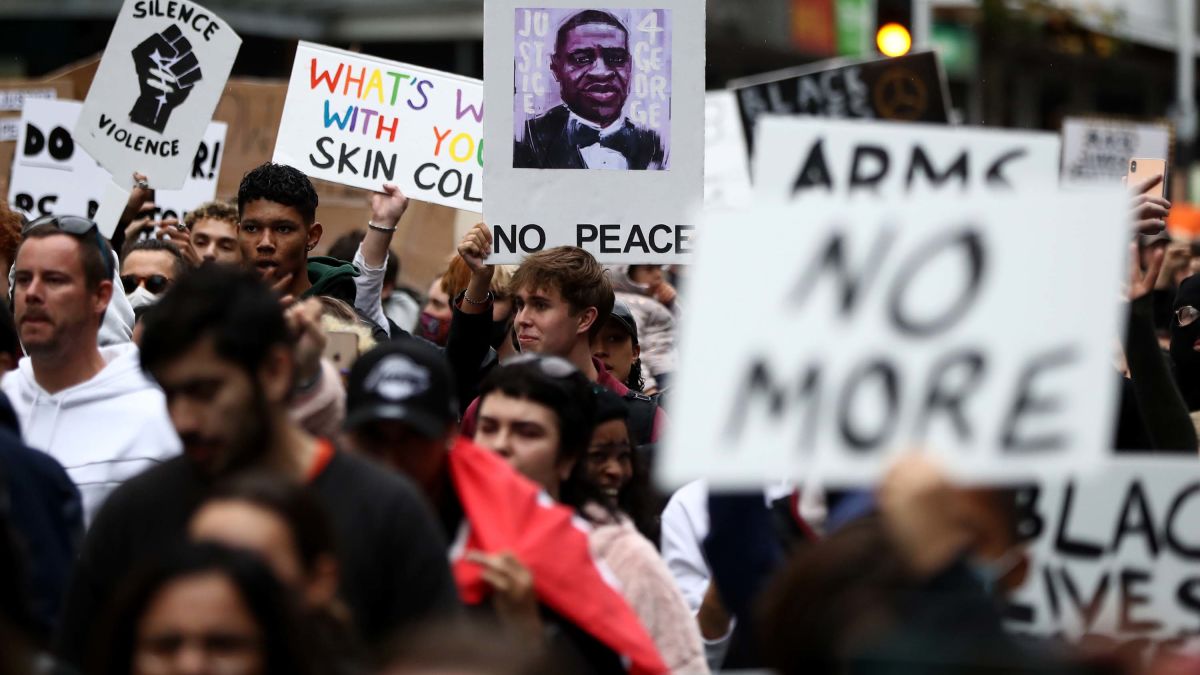
In the wake of the nationwide rise in Black Lives Matter protests after the murder of George Floyd, American journalists have been grappling with the ethics of staying objective in their reporting on racial topics. 

In reporting, objectivity is law. A green journalist is taught that their job is to gather, interpret, and report. They reject sensationalism and loaded word choice, no opinion - as a journalist you are simply a conductor for information to flow through. But who exactly is dictating the standards in being "objective" in today's society? 

Journalists of color have often been targeted in accusations of implicit bias in reporting when they push to label blatantly racist actions as such, especially when their words are targeting a white person in power. Critics argue that the purpose of a journalist is to gather information and report it to the people, not to assign labels; they believe that should be up to the interpretation of the reader to assign their own. But does objectivity cross the line when it contributes to a larger problem of normalized race-baiting and discrimination in our society? 

George Floyd protests, image courtesy of CNN.com 
 
President Trump's series of tweets against the four minority congresswoman in 2019 was a pivotal moment for news organizations like the New York Times and the National Public Radio (NPR), who released statements on their decisions as unbiased news outlets to classify the President's words as 'racist'. 

"Why don't they go back and help fix the totally broken and crime-infested places from which they came," said Trump in one of several tweets in 2019, seemly referring to a prominent group of four congresswomen of color: Rashida Tlaib of Michigan, Ilhan Omar from Minnesota, Alexandra Ocasio-Cortez of New York and Ayanna Pressley of Massachusetts. 

Reporting purists could argue that the decision made by NPR and the New York Times violated their codes of objectivity in reporting, but what does this mean, really? Journalists can use the labels "racially charged" or "racially insensitive" until they're blue in the face, but the word that is being danced around is already clear to most: racist. And while it may not be a journalist's job to assign labels, it is a journalist's job to relay real and inform the public of what is going on in the world. 

Should it be a journalist's job to jump through word-choice hoops to keep up a facade of objectivity, or should they instead be encouraging conversations on racial reporting and ditching the word-dancing habit?

As the United States continues in its systemic racial turmoil, it is worth asking if the idea of 'objectivity' in reporting works harder to excuse and conceal our country's racism rather than bringing attention to it. If the objective roots of fair reporting are only working to benefit one majority, it could be an indication that it is time to reevaluate our journalistic standards as a country.

Being Black and Reporting Racial Injustice

Mia White

Mw964917@ohio.edu


The year 2020 has been a big one to remember when it comes to racial injustices in society, but unfortunately, this has been happening for decades. But, have you ever wondered what the Black journalists feel when reporting said issues?

Glamour Magazine posted an article in June this year titled "8 Journalists on Reporting While Black, With the Weight of History on Their Shoulders". The first woman featured is Abby Phillip from CNN. 

"I have felt over the past weeks a little bit of deja vu, with the same narrative unfolding time and time again. And that is frustrating to me as a person. It's also frustrating to me as a reporter, because I remember covering Ferguson in 2014 and Charlottesville in 2017, and I was telling the same stories back then as I am now." Phillip says. 

Phillip goes on to say "I am often asked to come on air and talk about these issues, and I accept that. Since we're being honest, it is exhausting, and of course, there are times when you want to be able to just sit and not be on television, attempting to articulate the pain and anger that has built up over decades and decades."

Stacy-Marie Ishmael from the Texas Tribune was also interviewed. "But when you're working on things that also affect your life or the lives of your friends and family, there is no real separation between you as a person and you as a journalist. It's a continuum. I am also an immigrant. I'm an immigrant with access to good lawyers, sure, but I'm still a person who is affected whenever, for example, a new executive order comes down."

Photo source: The Dallas Morning News
 

It is common for many people in society to view journalists, reporters especially, as celebrities in some ways, whose lives are squeaky clean like we see on TV. That is just not the case. 

In May of this year, the New York Times also released an article on a similar subject matter titled "Black Journalists Are Exhausted" by freelance journalist, Patrice Peck.

Similar to what Abby Phillip says, Peck writes "I feel caught between two separate realities that are simultaneously separating and folding in on themselves. The old normal and the new normal; our society has changed drastically, while also not changing at all. I am pulled taut, straddling a time when the black community could safely gather to celebrate, praise, commiserate, mourn, protest and uplift, or simply just be, and I am pressed thin, experiencing deja vu as time repeats itself like a broken record."

There's that term again, "deja vu". Isn't it unfortunate? Outrageous? Sickening? It is a term that should not go unnoticed as two prominent Black journalists have used it to describe their work. What does that say about what the journalists have been going through for so long? What about the Black community as a whole? Why aren't the stories changing as time goes on?

Despite all of the hardships, Peck offers some advice.

"Despite wanting to publish my newsletter on a regular basis out of fear of losing subscribers or being considered uncommitted, I recently took a week-long hiatus: Caring for myself would only strengthen my work and passion for the longterm."

"Investments in black journalists is critical, not only through equitable compensation for our contributions but also in addressing burnout, layoffs and mental wellness, particularly in those of us who keep on keeping on."

It is no secret hearing from these journalists that it can be exhausting to cover these types of stories. Only time will tell if this will continue for more decades to come, but hopefully, it will not.