Monday, October 30, 2017

Be Aware of Native Advertising

Garrett Raymond
Gr732313@ohio.edu

Native Advertising 

Advertising is everywhere and in many different forms. Some are more easier to spot than others, and some advertisements are created by news outlets to look like articles, but are actually advertisements, and that is where native advertising comes in. To put it simply, native advertisement is paid content. A company can pay a news outlet to run a "story" and the content could look, feel, and read exactly like the news outlet's articles, but isn't created by them. For native advertising to work, the content must align closely with the outlet's voice and format. For people, this type of advertising is hard to spot and that is why it is so important to identify it.

Problems with Native Advertising

"Don't trick them. Don't piss them off."

Those are wise words from Eric Goeres, director of innovation at Time Magazine. Goeres is referring to everyday people when he says "them" and is the greatest problem with native advertising. People don't like to be fooled, and this type of advertising can be misleading. If a news outlet is paid by a corporation to publish an article, how truthful do you think that article is going to be? Or would you even know it was paid for? The same goes for a review of a product. That reviewer might have been paid off by the company to write a good review, how would you know?

Another problem native advertising has is it doesn't help the brand outlet much. Take a credible, huge audience outlet like the New York Times. If they used native advertisement for their newspaper like Buzzfeed does the NYT would lose a lot of its audience and maybe think they sold out.

According to a study from Phys.org only 7 to 18 percent of readers could tell between a real news story and a native advertisement. Those numbers are scary to think about when we're already surrounded by advertisement and only a handful of people know what they're really reading.

Not All Bad 

Some native advertising can be useful though, some instances it makes for good advertising. An example of this comes from WorldStream.com involving UPS and Fast Company. Fast Company put an infographic of UPS's supply chain management on their website. It looks "virtually indistinguishable" from the content Fast Company publishes. The only way you can see it is an advertisement is from the little gray "Advertisement" tag at the top.

Fast Company Infographic 

Without the advertisement tag on top of the graphic, I was not able to tell whether this was a graphic to a story, or an advertisement. 


In conclusion, native advertisement might be harmless from first impressions. But, if people can't tell a difference from an advertisement and a news story, news media loses credibility and that's going to be the news people get. 


Advertising in Today's World

Hannah Schie
hs538514@ohio.edu


New Media

Many companies now engage in earned media and native advertising. Earned media is media that is free and the result of interaction between the company and the consumers. That being said, it is much more difficult to earn attention for your company through earned media than your average paid advertisement. Social media, unsurprisingly, is the place where a lot of this earned media is coming from and taking place.

Native advertising has also been on the rise for the past few years. According to the website Sharethrough, native advertising is "a form of paid media where the ad experience follows the natural form and function of the user experience in which it is placed." Sharethrough's website gets into specifics on how consumers react to native advertising on different platforms and viewing habits. Although it is paid advertising, native advertising may be just as effective as the earned media that is free.

I encounter native advertising on Twitter and Instagram very frequently, and I do find that I spend more time looking at the content that is integrated than I would if a random banner popped up at the top of the feed. Personally, I don't think I prefer either earned media over native advertising or native advertising over earned media, even though I tend to trust earned media more. In this sense, my personal thoughts on native advertising are positive.

Credit to RS Web Solutions


Negatives of Advertising

Fraudulent advertising continues to be on the rise as technology advances and as the social media world continues to grow. There are four types of advertising fraud: Bot traffic, ad insertion, robot retargeting and CMS hacking.

Although the fraud is bad, companies do benefit from the boost in web traffic and website performance. Since the fraudulent advertising is in some ways helpful, it is a dilemma for many brands as to whether or not they should take action against these hackers and robots.

False advertising has become harder and harder to accomplish over the past decade, but many companies still participate in smaller ways. With the rise of social media platforms, a company caught lying to their consumers about their product and its effects can be spread around in a matter of minutes or hours. Advertising companies balance how much information they need to tell their consumers ethically with the full truth.

Subliminal Advertising

Most people come into contact with subliminal advertising each and every day, whether or not we know it. We, the consumers, have been tricked into thinking we need many material items from specific brands and companies.

Many brands now know that they have loyal customers, many who will pay almost any cost for their products. In reality, many brands sell almost the exact same products and just print their own brand name onto it and change the price. Nike and Target could sell almost the same pair of shoes and Nike's pair would cost at least twice as much.

Personally, there are a few brands, like Nike and Adidas that I know I will pay a few extra dollars for, due to their product quality, but I'm sure I've also been affected by subliminal advertising from these brands without even realizing.


Drawbacks of Advertising

Andrew Sudnick
as628713@ohio.edu

For organizations, advertising is the key to promoting their product. It is seen as effective way to help with sales. However, many people do not take into account the harms of advertising. Unfortunately, not every organization is selling a harmless product/service. Some organizations also use unethical methods of advertising. I think there are three main negative results of advertising.
Source: pixelpi.com

Susceptibility

Advertisements can be the most lethal when they are targeting a susceptible audience. This can be harmful because it can lead to rash decisions by the consumer. Targeting someone who has their guard down could result in a negative manor. The most susceptible audience is children. Kids are very impressionable. Advertisers factor in many sophisticated devices so they can determine the most effective way to influence these children. Advertisements constantly effect children's well-being. Certain ads can cause children to chose unhealthy habits. This is unfortunate because they are not developed enough to make decisions on their own. Advertisements capitalize on the susceptibility of children, and it often is at the child's expense. 

False Representation

A lot of advertisements are competing against rival products. There is a lot of pressure to make your product stand out and seem like the clear-cut winner. However, this results in falsely represented ads. It is illegal to advertise your product falsely. Organizations are so talented at showcasing a product to the point where you imply it's benefits. This keeps the organization from getting in trouble, but also sucks you into the ad. False representation is frustrating because you buy the product and it turns out to not be what you expected.

Manipulation

Manipulation, in advertising, refers to the emotions a certain ad draws out of you. Ads are created so you desire the product/service being advertised. Often, this can be harmful because it leads to you comparing your life to the ads. It pulls that desire out of you and makes you feel like you are not good enough the way you are. They target your insecurities so that they can lure you into their product. Ads specialize in making us believe that buying stuff will lead to happiness. They create an emotional problem, then offer a solution towards it. Manipulating you and making you feel down is the first part; then having the exact cure for the problem is the second part. They want to provide you with short-term happiness, as long as they get your money first.
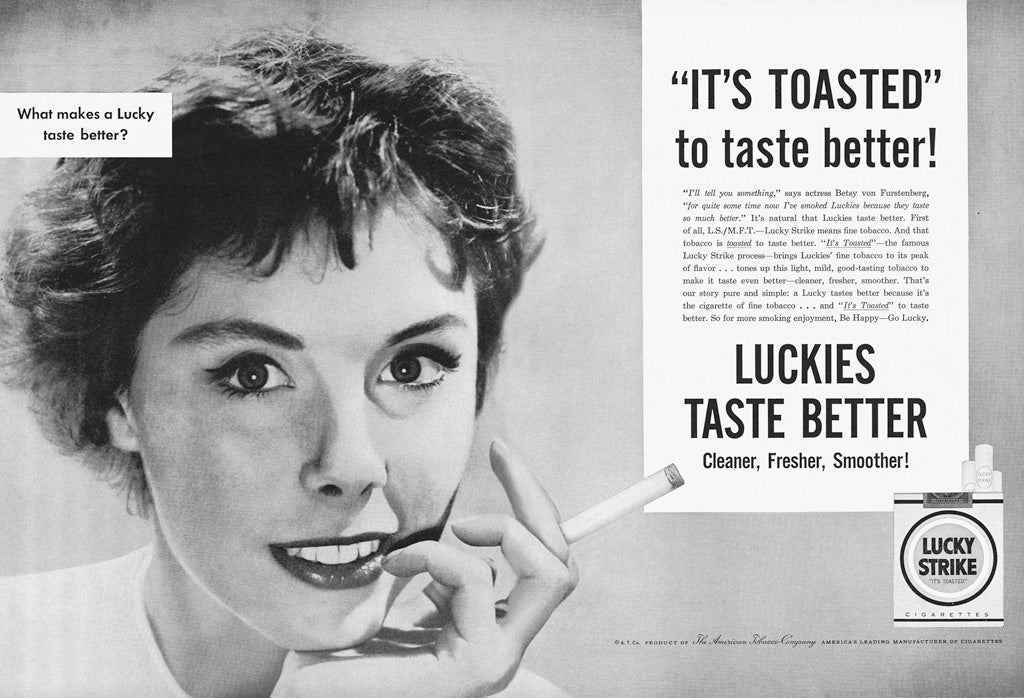
Source: tobacco.stanford.edu

Sunday, October 29, 2017

How to Catch False Advertising

Tricia Tighe
pt636013@ohio.edu

                            Airborne is the company that had to pay millions for false advertising
                                                             Photo Credit: ebay.com

Advertising often gets a bad connotation for not being truthful or stretching a white lie. If a company is not careful with how they portray their products it could cost them millions.

For the company Airborne, it risked their product and losing millions of dollars for having false claims. Airborne was marketed as a product that could boost the immune system lessing the chance of getting sick. They targeted the common cold and flu saying that it can defend against germs.

Airborne tried to create a slogan "It's the one designed by a school teacher" to make it more relatable and trustworthy for consumers. They also stated that taking the product in airplanes, schools, restaurants and offices could protect from any unwanted germs.

Ultimately, a lawsuit was filed against Airborne for false advertising. They were found guilty since the ingredients were not proven to actually boost the immune system The FTC ended up winning around $30 million for all of the inaccurate claims.

According to NPR, a senior nutritionist David Schardt stated that taking Vitamin C is the best way to improve the immune system. Some consumers are still buying Airborne believing that it will help prevent getting ill.

There are ways to spot false advertising so a consumer is not getting duped. Advertising can be easily construed to get consumers to believe a product or to increase sales.

The Advertising Standards Authority has listed tips on how to catch an incorrect information and for marketers to ensure that their advertisements are meeting up to standards. The ASA stated that "In 2014, around 70% of complaints the Advertising Standards Authority received related to misleading advertising..."

The first tip is to to clearly give information especially the key details that will support the claims. This is so all of the information is laid out and there is not any room for interpretation.

Pricing should also be clearly described and to add any possible charges. This can be easily deceived when there is extra pricing added into the fine lines or saying that there is a store wide sale with 30% off when not actually everything is.

Be truthful on what a product offers and works because this is where the misunderstanding lies. Taking the product out of context or overemphasizing is where it can make the claims false. This does not make consumers build trust but rather ruins it.

Evidence that support the claims are vital to prove that a product is all that it is cracked up to be. Consumers are going to want to see the research put in for showing how a product works. Similarly, having details be clear can attract the trust of audiences.

Finally, product names can also be a clue in trying to entice instead of giving the truth. APA states that if a product name gives a benefit or effect that is not proven than it will be false.

Advertising is a great tool to showcase how a companies products can work effectively if it is used properly.

Subliminal Ads: Are They Ethical? Are They Real?


Jaida Sterling
js528714@ohio.edu


Subliminal messages in advertisements have been a topic of discussion for years, but what most people do not know is that they are not real.

The New York Post wrote an article about whether subliminal ads were real or fake in 2012.

They (an other news sources) said the idea of subliminal messaging started off as a hoax created by a researcher named James Vicary.

This hoax was about how Vicary placed the words "drink Coca-Cola" and "eat popcorn" for a short moment during a movie for a few weeks, then said the experiment "boosted Coke sales by 18% and popcorn sales by 58%."

However, this experiment was just "a gimmick to attract customers to his failing marketing business."

This realization of it being a hoax did not stop people from thinking that subliminal messages in advertising were real and impacted people's decisions in a major way.

The argument is that if you can catch the subliminal message, then it is not subliminal.

One of the most memorable "subliminal" message scandals was a George W. Bush ad aimed at Al Gore that ran the word "RATS" quickly across the screen.


People felt like this ad was trying to persuade people into picking Bush over Gore, and after people protested, it was taken down.

A political psychologist, Joel Weinberger, found that "subliminally flashing the word "RATS" in a television ad can indeed increase the negative ratings of a politician."

But is attempting to "subliminally" persuade people to do something worth it?

Vox's article, "Do subliminal messages actually work?" mentioned subliminal message experiments that showed that they give people a little push to do things that they were already inclined to do, but are "probably not worth the investment."

In an article written by BBC in 2015, it talked about a group of social psychologists at the University of Utrecht who were able to make subliminal advertising work in a strict laboratory environment with little effects.

Their work concluded that "subliminal advertising was only effective with products that people knew of and somewhat liked."

People are not as easily manipulated as some might think.


It talked about how some subliminal ads purposely aim to unethically influence and "inappropriately target a particular market."

Although there are not any specific laws that ban subliminal advertising, consumers are able to sue those they believe are causing harm to them through these advertisements.

The Federal Trade Commission requires truthfulness in the ads advertisers decide to create, and if they violate "truth-in-advertising laws by using false subliminal messages" they could potentially be fined.

Psychologists and ad experts still debate about how effective subliminal messages in advertisements can be today.

Many have found no evidence linking subliminal messages to human behavior after being exposed to these messages.

Even though it has been proven time after time that subliminal advertising does not impact people's decisions or behavior greatly, there are advertisers who still attempt to control behavior through this method.

These advertisers with their attempts to "control consumer behavior are widely perceived as unethical."

Tuesday, October 24, 2017

Truth in PR for starters

Efemena Efeurhobo
ee055313@ohio.edu

As Donald Draper once said "What you call love was invented by guys like me...to sell nylons. Public relations with advertising makes an interesting duo. Many people have this perception that we just put up or sell an image to uphold our status and make money. The definition of public relations is the maintenance of a favorable public image for famous persons, companies, and organizations. On the other hand advertising is the action of calling attention to something whether that be a product or someone.

People need to realize the world is changing. Yes it more revenue driven especially now with "annoying" ads that pop up when your reading articles, magazines or watching any sort of content. We need to understand the drive behind that and at the end of the day it is money. Money makes the world go round. We PR/Advertising people can't be the ones to take the blame for something like this.
Via: https://static.independent.co.uk

Brace Yourself

People clearly want to look good in this day and age. No one wants to ever look bad and people want to be perfect and have a perfect image at all time. The reporters decreased by 17% and the public relations specialist jobs increased by 22% and even making a whopping 20k difference in salaries. Shift from traditional advertising codes to , it's all about branded content now.

"Telling great stories about a company in a more intelligent way instead of extolling a products merit" It's all about aesthetics nowadays and I'm good at aesthetics. It's not necessarily a lie, but showing something in it's best light. For instance an Instagram photo. You might not look as good as you do in person, but with the right aesthetics you can make your strong points show. Branded content is such a big super power in modern media business.


Follow the leader

Make sure the workplace is running things ethical. It can be hard because of CEOS controlling the culture of the workplace and putting pressure on employees. Working in Pr/Advertising can be fun and games, but it is hard. You have to think of what your client wants and what also sells really well. You have to somehow maneuver the feelings of your clients and somehow yield the best results through your work.

In the readings they talked about PR and how it relates to modern communications. Being a strategic communications major I definitely relayed in what they were saying on how things are moving in a completely different direction now. I am glad with the major I have chosen because it is relevant in today's age. Having the knowledge that I know and the articles reiterating how important Strategic Communications is that having a very good image is crucial to a company. So crucial that they are willing to pay decent money for people that

At the end of the day company employers will always try and look above to their superiors to do the best work and create a good image for them. I believe this kind of environment also pushes Strategic Communications in the workforce because that is what it is all about. People have a misconception of what people in the public relations and the advertising and they shouldn't as we are just rolling with the times.


Via: https://i.pinimg.com


The social media era & the effect on mass shooting coverage

Jordan Klimack
jk318014@ohio.edu

The social media era has changed journalism. The effects have been both beneficial and detrimental to the field of journalism. For example, the average person has access to news and information at the tap of a finger. Likewise, journalists have the ability to reach a larger audience via social media. In turn, this has created a competitive environment in the field of journalism that is unprecedented.

Social Media has allowed news to be reported across multiple platforms
Image via esoftload.info
The field of journalism will never be the same. Right now, personal ethics codes are of the utmost importance. News coverage of events such as mass shootings or tragic deaths has become an arms race--to see who can report information the quickest. Often times, this has led to journalists foregoing the proper steps to publishing their work. This involves publishing news or stories without the proper guidance of an editor. In turn, this has led to errors of fact and grammatical errors that have damaged the perception of journalists, across a country that always has an appetite for a good news story. 

In the case of mass shootings such as the Sandy Hook incident, or the recent Las Vegas shooting, which claimed the lives of over 50 Americans, journalists need to respect the privacy and mourning of not only the families of victims but the community, as well. Personal ethics codes come into play in this situation, as well. The journalist needs to consider what is ethically and morally correct, in dealing with the families of victims of a shooting spree. As noted before, social media has propelled journalists to report information as quickly as possible; this also involves the need for sourcing, in a timely manner. However, most families are not ready to talk about the incident just days or hours after tragedy has changed their lives forever. Journalists need to realize the importance of a good and credible source. Likewise, your best story may not be the quickest story reported, but it may be the most impactful. A sit down with a parent of a victim weeks after tragedy struck carries a lot more weight than a jaded quote that was obtained through an unethical-invasion of privacy just hours after the tragedy. Reporting of tragic shootings is not a game. Lives were lost and families are in mourning. It is time ethical journalism over-takes the need to be the first to report a story. 

Families in mourning are entitled to privacy, following the tragedy of a death
Image via dailymail.co.uk
Furthermore, social media such as Facebook and twitter are flooded with images that can represent or misrepresent a certain instance. Often times, a twitter user can scroll through his timeline and be presented with image after image, without clicking on a story. This has become an issue with the reporting of mass shootings. In the United States of America, news media will present images of an armed-shooter to provide context and reasoning to why a tragedy has taken place. This has enabled shooters such as Stephen Paddock, the Las Vegas shooter, whose image has been pasted all over social media and in the back of the mind of American citizens across the country. It has provided a fifteen-minutes of fame mind set for those contemplating a mass killing. The media needs to understand it's role in these attacks. 

Social media has perpetuated mass shootings across the world. Journalists and members of the media need to understand their role in these attacks --it must stop once and for all.