Monday, March 14, 2022

Cash for Clues: Crucial or Corrupt?

 Alex Fredecker

af333117@ohio.edu

At its core, journalism is obtaining and distributing news and information. This concept is not new to most but has existed for over five centuries. 


However, the means of acquiring such information is often disguised as ethical journalism or entirely undisclosed to the public. 


One of these means of obtainment is labeled as checkbook journalism. According to the Society of Professional Journalists, checkbook journalism is "the practice of paying for information" and is a significant contributor to the corruption found within the industry. 


The Purpose of Checkbook Journalism

While some sources may feel an ethical obligation or have a personal reason for reporting information, others may feel at risk to disclose what they know or see the reporter as a gateway to acquiring a profit. Therefore, reporters often resort to paying these sources to obtain pertinent information. 


An example of checkbook journalism that has occurred in the past is Bill Clinton's 1992 presidential election campaign. Throughout this campaign, Clinton was accused of having an affair with an Arkansas state government worker, Gennifer Flowers. 

As Clinton denied these allegations, reporters became more and more curious about Flowers' side of the story. Finally, to convince Flowers to reveal the truth of the situation, several reporters paid her thousands of dollars for information and interviews.  

Gennifer Flowers on-air discussing said affair
Photo provided by CNN

Although she was at risk of losing her job and reputation, Flowers came forward after receiving several generous offers. Although this may seem unrealistic, as it is an infamous case involving several critical public figures, these scenarios also occur on a smaller scale. 


Conflict of Interests Within Checkbook Journalism 

Although reporters may often feel that they are left with no choice in gathering information but paying the price, this choice is also labeled as corrupt and unethical by many. Therefore, the conflicts of interest within checkbook journalism lie between the reporter, source, and public.


If a reporter chooses to compensate a source for valued information, they succumb to the risk of said source simply stating what they believe the reporter wants to hear to make a profit. Although this is not always the case, it creates the possibility of spreading false news to the public. Then conflicts of interest occur as the need for a story, the want for money, and the right to the truth meet. 


Should Checkbook Journalism Be Outlawed? 

Although checkbook journalism is not considered illegal, it is undoubtedly deemed unethical by several news organizations, including the Society of Professional Journalists. For example, SPJ's Code of Ethics warns journalists to "Be wary of sources offering information for favors or money; avoid bidding for news." 


Therefore, checkbook journalism can undoubtedly be considered controversial; however, should it be outlawed entirely? 

Wednesday, March 2, 2022

Context is key when perceiving political ad campaigns.

 Maxwell Abbatiello

ma281019@ohio.edu

From Medium

In the digital age where misinformation spreads like wildfire, it is unwise to cut corners when considering the credibility of information on the internet, especially regarding politics. Platforms have been accused of using advertising to influence elections, especially Facebook. Finding the right way to navigate through political ad campaigns can be difficult. Context is crucial when going about perceiving these campaigns.


Candidates will use anything they can to damage the image of their opposition. During the election process, candidates will attack ads that aim to attack the other candidate's reputation. The first occurrence of an attack ad took place during the 1964 presidential election between President Lyndon B. Johnson and Senator Barry Goldwater. President Johnson ran an ad titled "Peace, Little Girl," which essentially conveyed that there would be a nuclear war. 


It is no longer the 60s, and there have been developments in how candidates campaign. A significant shift occurred during this past election between Trump and Biden. Trump utilized social media, particularly Twitter, to pick and poke at the Biden administration. For example, a clip of Biden was taken out of context that made it sound like he was admitting to voter fraud: "We have put together I think the most extensive and inclusive voter fraud organization in the history of American politics." This quote was tweeted by Fox News reporter Kayleigh McEnany and was quickly blown out of proportion. Biden was trying to say that he has put together a team to fight the potential legal action Trump was threatening to take due to his allegations of voter fraud.

When viewing a political ad, it is essential to ask yourself questions: What message is this trying to convey? What is the context of this ad? Being media literate is more important than ever. Remembering what biases news organizations have is crucial when answering these questions. Fox News is more conservative, while CNN leans left. Also, not falling victim to confirmation bias is essential. Keep an open mind and only believe what is factual. Also, remember to always be on the lookout for fake news and misinformation. Kamala Harris faced controversy after a claim went viral that she slept her way to the Vice President. This story isn't true, but many believe it. Context is important when deciphering these messages

Combatting partisanship through intelligent interpretivism and public engagement


While reading Bridget Thoreson's August 2020 article in Poynter about a trending involvement of the community in the newsroom, I was surprised. It seems so apparent to involve the public with the news, especially the interviews and polling, to figure out what most people want to see in the news. Why does it seem there is a division between the journalist world and the media consumers? The general public is those we are supposed to be serving. Why wouldn't we consult them on the types of things they want to see in the news? That is especially an issue in political journalism. Pew Research center outlines just how divided Americans are politically in this article. How have we been involved in such a substantial partisan divide as a nation? I suspect that news organizations are to blame. It is no coincidence that the polarization of the United States has accompanied the significant consolidation of the nation's media. Now, there are countless corporate sponsors with vested political interests controlling almost all American media somewhere up the chain. That's not to say that an oil baron vets every piece published, but there is undoubtedly pressure to make news conforming to a specific ideology. Diversity is the greatest asset to free information, but when six megacorporations control most information, you have to wonder about the quality of political journalism. 

Perhaps some of these tensions could be eased by a more bottom-up approach to political stories where the general opinion of the local community is gauged and shared and then used to contextualize the information coming back from the statehouse or Washington D.C. Undoubtedly, facts are always the facts, as Harry Bruinius mentions in "Why journalism is shifting away from 'objectivity,'" non-partisan, strictly-facts reporters are being drowned in a constantly changing media environment and partisan fighting. Consumers don't necessarily want content that fails to take a point of view and offers a false balance. They want intelligent observations from journalists who are not pushing an agenda but are true to their ethical and moral values. It is essential to acknowledge that having a code of ethics as a journalist does not mean you're partisan. Still, as a journalist, you have to be careful not to fall into unconditional support for one party and hatred for the other.  

Tuesday, March 1, 2022

Social Media: How does it affect the way we view our countires narrative?

Brayden Adkins

Ba144319@ohio.edu

Many people have experienced growing up with social media living in a digital-first world. For many teenagers growing up, we often gain knowledge from social media outlets such as Instagram, Facebook, and even Snapchat. On many of these Social Media outlets, many young adults find information from different popular mainstream news sources that allow them to receive important news worldwide. The world is changing, and the Journalism world is changing with it; we see more and more news transfer digitally to your electronic device more than ever. 


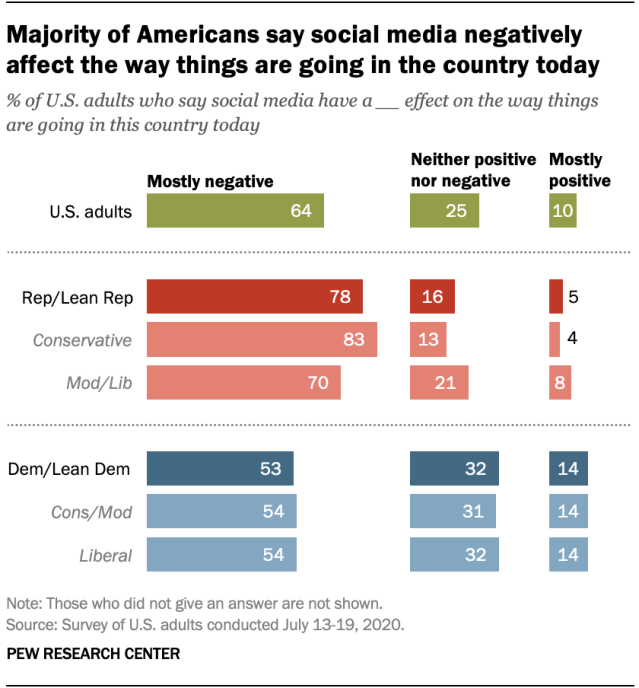
Although social media has allowed us to receive mainstream news to our fingers, many people perceive fake news, especially in politics. Growing up in a digital age, I have learned that it is easy to believe in so-called fake news, and it's easy for you to be faked out by what you may see or read on social media. The Pew Research Center did a study, and they found that "about two-thirds of Americans say social media had a mostly negative effect on the way things are going in the country today." In addition, Pew Research Center also found that many Americans believed that there was "major misformation in the hate and harassment they see on social media." This information is concerning when it comes to politics and especially political elections. This practice raises many questions when trying to figure out information about a political candidate on what is true and false. With so much facility in social media, you may ask, how do I know the difference between real and fake news?


Majority of Americans say social media negatively affect the way things are going in the country today

Image from the Pew Research Center

Through the portrayal of fake news, we must learn not to believe what we see at first glance. When viewing news on social media, we are often put under the persona of short video clips and memes that may not tell the whole story. As journalists, we often must do research before portraying a story as real news through a fact-checking process, such as finding the source is, have they done stories in the past that were considered real news, and where they may be reporting from. Looking up our sources allows you to consider if the source is authentic and gain more knowledge on the issue. Although fake news has become a significant persona that we see in social media, educating ourselves is the only way to defy the fake news narrative.  


Fact or Fake News: Facebooks Influence on Politics


 Jamyson Butler

jb935918@ohio.edu  


Photo illustration by Dado Ruvic/Reuters

For years, Facebook has had the attention of many people, no matter the age, race, gender, etc. Many social media users go to Facebook for a lot of information these days, such as selling or purchasing items, checking the weather, connecting with the neighborhood, and getting the latest news. It is an outlet for almost anything and everything. In turn, you never really know if what you see on Facebook is truly real or fabricated. 


Social media platforms maintain their audience and number of viewers by the app. If the viewers find censored information, they are likely to go to other platforms to find alternative information. So the fact that you can find both factual and fake news on Facebook keeps the viewers entertained enough to keep coming back. It is merely all about the drama. 


People tend to get sucked into the drama created on these platforms. Especially the adults who are super involved in politics and voting. Around election time, Facebook becomes a hot spot. There are countless ads and even posts from users about the candidates running. The viewers become infatuated with the heated platform and can't take their eyes off it. They even have an "I Voted" innocuous-looking that is a mighty button.


However, some would say that Facebook does not influence the election results. Some would believe that people may have already created their own opinions, and Facebook will not change that. It can also depend on how influenced someone is by others. Someone's mentality means a lot in this situation. Furthermore, even Mark Zuckerberg stated that the idea that Facebook influenced the 2016 election is just crazy.


Sometimes people tend to see a political ad on Facebook and believe everything it says without even fact-checking or further research. Then, they share the post on their page, and it is just a trickle effect from there. Eventually reaching millions of other users who the ad might influence. It has been shown that the brain decides to think consciously about it first. So, subconsciously, most humans react this way on social media platforms. 


It will be an ongoing debate whether Facebook influences people's opinions on politics or political campaigns. Of course, it can go both ways, but in the end, it is ultimately how the viewer chooses to react to the information they are given. 


The colorful tint of Social Media in politics

 Maria Denny 

md964019@ohio.edu 

Photo by Pinclipart


The act of scrolling through social media often becomes convoluted by the mix of two simple colors, red and blue. These two colors are highly symbolic and can be understood by millions of educated viewers. These two colors represent the most prominent political parties in American politics, the Republican and Democratic Parties. 


However, these colors may be seen as black and white to uneducated viewers. That color is a popular deceptive tool that many political organizations use to lure in the oblivious crowd that will repost anything that relatively resonates with something they believe in, whether or not it is factually correct or not. Unfortunately, these individuals do not pick up on the propagandistic force that political outlets present to the public. 


Finding the truth in the media is something that Americans struggle with when scrolling through social media. According to a study from BYU, they discovered potential rabbit holes that students dove into when spending time on social media, like Instagram. BYU public relations professor Pamela Brubaker claimed that social media users sometimes only interact with content that reflects their views. Unfortunately, those habits lead to the apps suggesting other similar content. This practice has caused people to dive into 'bubbles' that have caused viewers to be sheltered by one color and not ever exposed to the opposing political color. 


A recent study proposed by Pew Research Center uncovered that Americans who mainly get their news on social media are less engaged and less knowledgable than those who get their news from other outside news outlets. Further, they uncovered that one in five adults falls into this category, which equals 20% of the voting population in the United States. 


Political candidates on every level should be concerned that a fifth of their audience is uneducated and can be swayed by a simple Instagram post produced by someone with an influential agenda. Unfortunately, powerful accounts represent political colors that may be shiny to a large part of the U.S. population.  

Many things are needed to be done to change the narrative about receiving news on social media. Censorship and fact-checkers are necessary for this trend to continue positively. If this continues to spiral in its current direction, the American political future is quite literally doomed. There is technology to help fix this situation and the people. It is just a matter of time before it is introduced into the platforms in a balanced, not biased, color-educated fashion. 

Should I Stay or Should I Go: How Facebook Impacts Political Views

 Silver Barker 

sb230419@ohio.edu

Illustration from The Press-Enterprise

For years and years on, the media has increasingly been known to play a massive role in how people retain their daily news. These media platforms allow their users to act as consumers and give them a space where they can interact with what they read and share their opinions with the public. Facebook, the mother of these platforms, has reached a wide-scale audience of users, including different ages, ethnicities, and even partisans. While fake news has been a term presented way before Donald Trump's presidency, it did not take over social media until the rise of the Trump Era. In recent years, Facebook has highly impacted how this nation views political candidates and news outlets. It seems to have become more common for people to use the media to determine whether a candidate is worthy of their vote. 


This practice has caused a problem for these candidates, and the watchdogs who are expected to report carefully and provide accurate content on these platforms, or else their words could be misunderstood. The drastic measures that the public will take to spread information via media that could discredit and harm a person's career/lifestyle proves just how controversial politically motivated statements on media are. People rely so profoundly on the media that they tend to gravitate to the campaigns/ads/ and statements that favor their political views. This practice would be okay if all the content were from objective news outlets with primary sources; however, the problem is that it is not, meaning not everything they see is true. As Facebook creator Mark Zuckerberg states, the company has shown a "broader impact... from giving people a voice to enabling candidates to communicate directly to helping millions of people vote." While that may sound like an ideal opportunity because people can finally voice their concerns and share with the community, it also creates trouble because anyone can get on the platform and say anything. 


There are many real-life scenarios of this issue being played out. More currently, several well-known political figures, including Kamala Harris, have been victims of this online spread of false information harming their reputations. In August, Steve Baldwin had posted a statement on Facebook mentioning how he remembered Kamala Harries for having her career launched after sleeping with Willie Brown. While Harris did date Brown long before her election; however, this did not matter, and it was too late. What Baldwin had just thought was a simple post had turned into a harmful accusation of Harris and many women in politics sleeping their way up the ladder. There were sexually-related cartoons and rumors of Harris being sent across the media. Most of the people sharing it were conservative commentators who did not favor Harris being in office. Baldwin, later on, admits that he regrets what he had said because he witnessed his words become twisted in a way to work against and discredit Harris. He also highlights an opinion that needs to be emphasized more on social media in which he needs "to be more careful... and does make me more skeptical of other posts that I see." Social media, especially Facebook, are not trusted platforms because they do not fact-check political ads


All of this talk about social media users being able to interact with their community and candidates raises the question of how we, as a freedom of speech country, continue this transparency but in a way that avoids toxicity. Some news organizations have already taken a step toward accomplishing this task. For example, the Santa Local Cruz newsletter has shifted its focus toward the people's responses by asking the community what they would like to see more of in their candidates to receive their vote and publish these responses upon release of their weekly publications.